4
Question 4
Question 4:
Diagram 4.1 shows of apparatus set-up for an experiment carried out by a student.

Diagram 4.2 shows a graph plotted based on the results of the experiment.
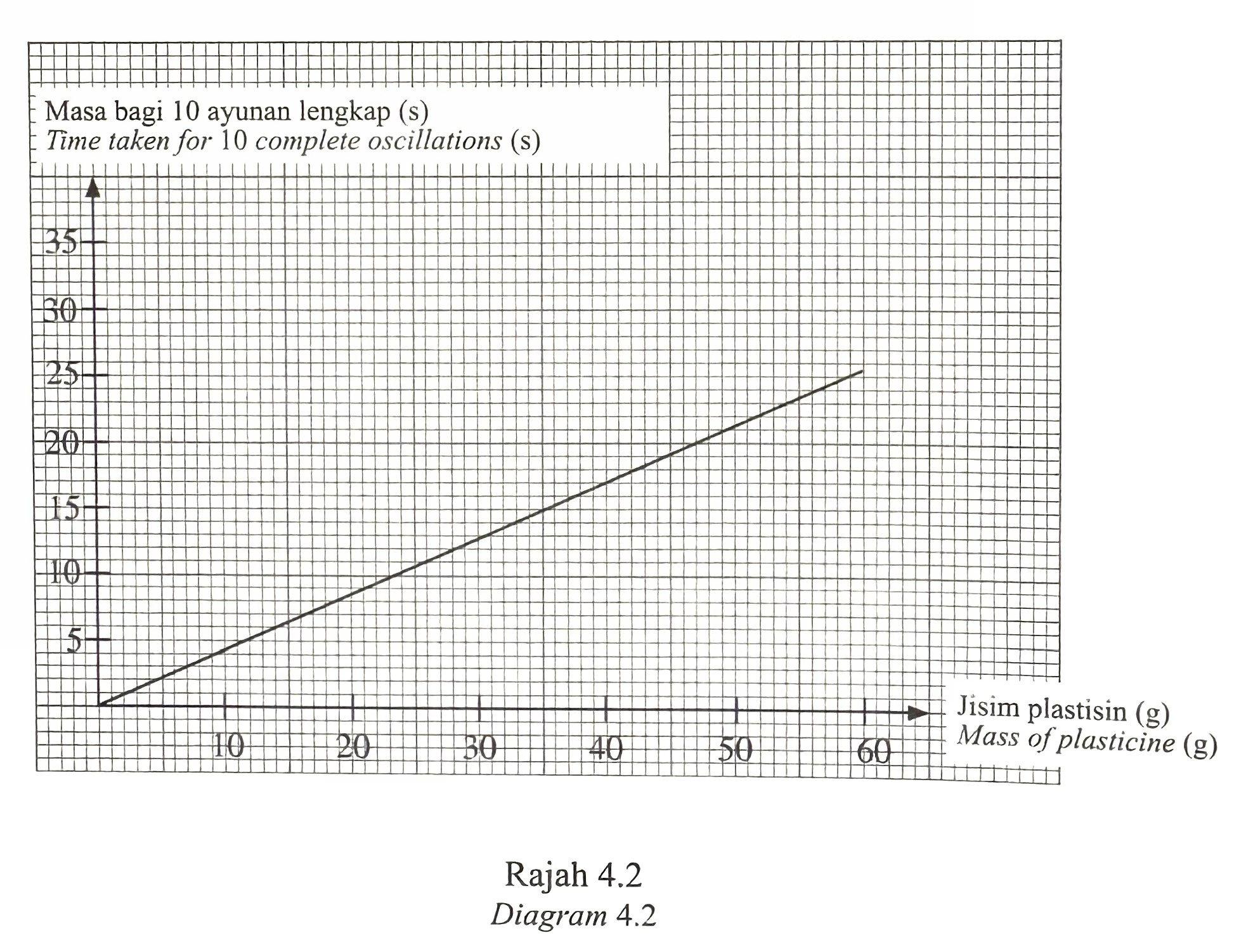
(i) (1 mark)
the mass of plasticine that can produce the longest time of 10 complete oscillations
[1 mark]
(ii) (1 mark)
the mass of plasticine that has the biggest inertia
[1 mark]
(iii) (1 mark)
time taken for 10 complete oscillations if the student uses plasticine with the mass of 35 g.
[1 mark]
(b) (1 mark)
The larger the mass of an object, the larger its inertia.
By referring the graph in Diagram 4.2, prove the statement.
[1 mark]
(c) (1 mark)
State one apparatus that can be used to measure the time taken for 10 complete oscillations.
[1 mark]
Answer
(a)(i) 60 g
(a)(ii) 60 g
(a)(iii) 15 s
(b) The bigger the mass, the longer the time taken for 10 complete oscillations
(c) Stopwatch